


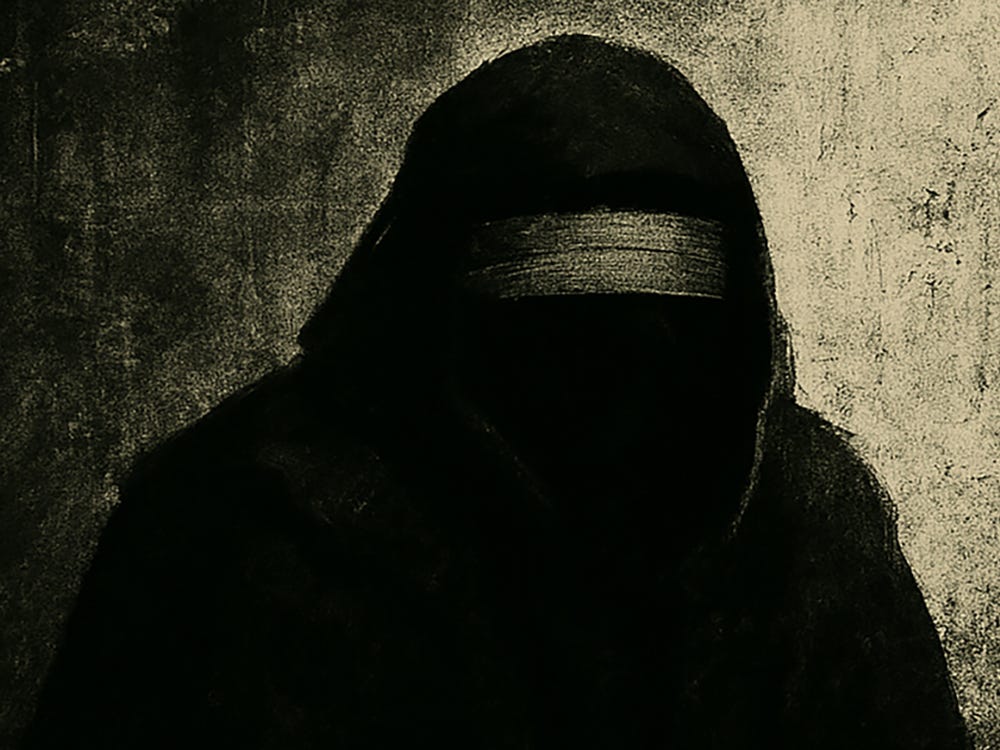
Banner image for ‘The Anti-Wizard’ by Garrett Crowe at 3:AM Magazine.
This post is the tenth entry in a series on editing fiction for 3:AM Magazine. Click here to read my introduction to the series, with links to subsequent posts.
I ended my overview of unreal fictions with those fictions that glimpse another world, then retreat into the world we’re more familiar with. In such fictions, the reader catches sight something illicit, slightly edgy, which remains unsettling—which has staying power—precisely because it is embedded in a larger, tamer narrative situation. To my mind, there are other fictions that often feel the same even though they are radically brief. These fictions are, in effect, all glimpse, embedded in nothing larger, and have an unsettling power that far outstrips the time it takes to read them.
When the key feature of these fictions is a strangeness of language, I think of them as shards. They leave me with the sense that I’ve been cut by something sharp and jagged, though I can’t say exactly what it is that wounds me. It has little or nothing to do with the narrative, because their narratives are often innocuous and inconsequential, but more to do with how the narrator remains troubled by events in ways they can’t explain. Effectively, I’m describing fictions of the Gordon Lish variety—with sentences that attack, torque, swerve, and so on—and at 3:AM you’ll find examples from writers who’ve admitted to taking Lish’s tutelage: see Carrie Cooperider’s ‘For My Money’ and three interlinked stories by Sean Ennis. Garielle Lutz and Amy Hempel are, in my judgment, the two most consistently impressive writers in the Lishian mode, but it’s extraordinarily difficult to write the way they do, to balance meaning against prosody with every word in every clause in every single sentence. I think Cooperider and Ennis manage to do that in these contributions to 3:AM and I’d love to see more submissions like theirs.
Elsewhere at 3:AM, Stella Fridman Hayes’ ‘I am my father’s daughter’ feels like a shard whose edges are all the sharper for the formal constraints that hew close to poetry, while Cole Frank and Charles Mines have contributed shards that cut in different ways. Frank’s ‘missileroot’ is a tightly compressed, slightly abstracted meditation on violence and survival that reminds me of one of my favourites by Gabriel Josipovici: ‘In the Fertile Land.’ That’s mostly due to the collective narrative voice reframing a desperate existence as a gift from providence. It’s also down to the spare, elliptical style that suggests, simultaneously, a kind of alien wisdom and an ignorance in wisdom’s clothing. Mines’ ‘Les Story’ is equally elliptical, though more from its use of the non sequitur and irresolution. Non sequiturs, in general, ask readers to ask themselves why sentence X should be followed by sentence Y—to descry the relationship between them—while also accepting the absence of an answer, learning to live with the feeling of a lack in comprehension. Irresolution is a non sequitur on a narrative scale, asking readers to ask themselves how to make sense of events whose causal connections are obscure. Both the non sequitur and irresolution imply significance without detailing it or justifying it. That’s part of what makes Les unforgettable, though we’re left to puzzle out why he shouldn’t be forgotten.
Alternatively, when a writer doesn’t so purposefully take issue with language, the result is less a shard than a splinter: a fiction that derives its staying power from the foregrounding of an unsettling image. Garrett Crowe’s ‘The Anti-Wizard’ is essentially only a description of a sinister figure who may or may not actually exist. Addison Zeller’s three stories unsettle by way of a collage, bringing together a series of discordant images—a flying object, an empty factory, a bottle of milk, the textures of taxidermied animals—while James Tadd Adcox’s three stories are more abstract, located in digital spaces, closer to images of the forms of things than of the things themselves. And I don’t mean to imply, above, that these writers don’t take issue with language at all. All of them do, in their own ways, only by heading in different directions to the paring-back of Gordon Lish. Crowe’s approach is painterly, allowing his image to accrete layers of light and shadow that alternately develop and obscure the visual details of his central figure; Zeller’s approach is repertorial, but with an emphasis on non sequiturs that mount up as the sentences unfurl, and Adcox’s is loquacious, involuted, philosophical.
Sometimes, but less often than via imagery, a splinter derives its staying power from an event embedded in a broader situation. In Homa Mojtabai’s ‘Pilling a Fast One,’ it’s the rush and verbosity of a drug high; in Katie Shireen Assef’s ‘The Visiting Poet,’ it’s a similar rush but a loss of language, the tensing-up of a narrator feeling a pressure to perform under scrutiny. In both of these fictions, the situation involves a younger woman feeling an attraction to an older man, or a man who at least seems mature even if he doesn’t have too many years on the narrator. But the event isn’t anything as basic as the development of a relationship between the two characters. Rather, it’s a distillation of time, the concentration of the narrator’s perceptions and thoughts into a single instant at which everything—her entire selfhood—seems to be at stake. What gets under the skin, in splinters like these, is the feeling of that distillation—as if a lifetime’s worth of experience is being jammed into a split-second—as well as the sensuous, torturous things that must be done to language to make the feeling communicable.