


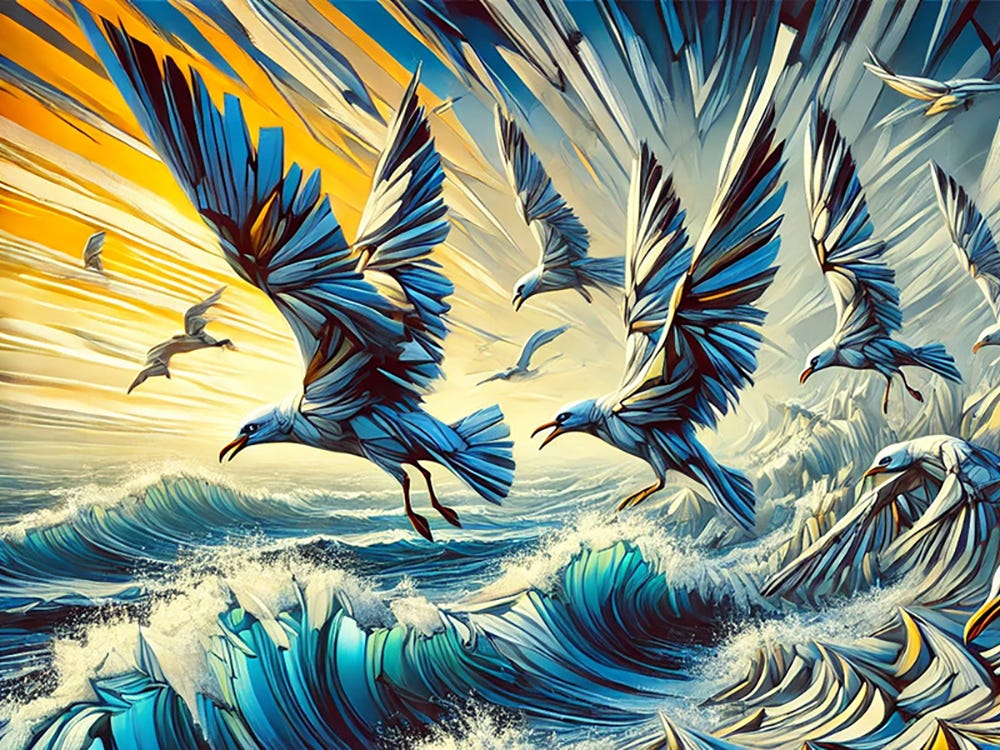
Banner image for ‘The Gulls’ by Albe Harlow at 3:AM Magazine.
This post is the eleventh entry in a series on editing fiction for 3:AM Magazine. Click here to read my introduction to the series, with links to subsequent posts.
It’s difficult to know what to say about prose poetry, or whether there’s much I can say that would be insightful at all. When prose poetry works, it works beautifully; when it doesn’t quite work—even just slightly—it’s disastrous. What makes a prose poem work, aside from the particularities of any one instance, is invariably the sound of it, more so than its sense. That’s not to say that the prose poems I’ve published are nonsense or pure surrealism. It’s rather to say that they’re not often made of component parts that have to cohere, narratively, so that sense-making isn’t much of a demand from the get-go. Mostly, in place of narrative, a prose poem has at its core either an image or a line. Mostly, then, being absolved of a need to tie its component parts together, a prose poem is free to bear down on a point of recursion (repetition, reiteration) or else to find a subject for variegated elaborations—and most of the editorial fine-tuning focuses on prosody, syllable stresses, the metrical beat of the lines.
For examples of recursion, see Eve Zelickson’s ‘Her Refrain’ and J.P. Seabright’s ‘The 145 to Dagenham Asda.’ Zelickson’s prose poem has a pyramidal structure: it builds up to a point with successive paragraphs that all open the same way—“While you [did X], she [did Y]”—then it reaches an apex with two paragraphs that open differently, and finally it slopes down again with a series of closing paragraphs that put a different spin on the same opening as the first ones. Seabright’s, in contrast, doesn’t vary at all, paragraph after paragraph opening with “For the purpose of,” until the words reach the very last paragraph: so that the journey to that destination, not deviating from the course established at the start, mimics the progress of the bus the speaker is riding on.
For examples of what can happen when variations are applied to recursion, see Elizabeth Bevilacqua’s ‘Warp and Weft’ and Ewen Gass’ ‘Variations on the First-Person Plural.’ Both writers seesaw between two points of repetition, each of which is amended and qualified as the words unspool. For Bevilacqua, those two points are simply an “I” and a “you,” and the “you” amends the desires of the “I” as the “I” notices changes in the nature of the “you.” For Gass, it’s not an “I” and “you”: it’s a “we” that at first speaks simply—“We [did X]. We [did Y]”—until the passage of time wears it down and different temporalities intrude on its voice: “We [had done/never did Z],” “On [such-and-such a day] we [did otherwise],” “Every day [we did something else].”
Examples of prose poems that opt for variegated elaborations are fewer: I’ve published just two at 3:AM. Zoë Meager’s ‘Local Bones’ opens with the alluring image of a person climbing towards the stars on a ladder of bones—but then it spins around, sends the stars earthward, turns against the climber, ends up with an empty cosmos, and concludes with the bones inside human bodies feeling more alive than the night sky. And, in ‘The Gulls,’ Albe Harlow takes a seaside setting and makes sentences full of mad, manic, cantankerous music:
When the seals hot-trot, the crabs walk. When the sand mites flicker, the sunfish prima-donnas beyond the breakers. The old-hand sandpipers strike at the backwash strandhoppers, have been since daybreak low. When apexers rove under the wind-white, five fingers out, somewhere, a patrol boat wakes a line of skiffs. The mollusks have already shelled the berm, on account of the gulls. Somewhere in the disappearing tidepool, the hippofish dawdle. At this moment, the shiners bolt under dapples of screensaver-blue. The green flies trifle at the ankles, beneath a canopy of hatred. The inland crane stalks while a fresh striper washes up rolling. The ocean claws away at the sand while the contingent hinterland smiles with fire. But the gulls always reap. The gulls, the gulls, the gulls reap. They reap at dawn and they reap at dusk. From morning till afternoon, they reap. Reap, reap, reap, the gulls—they reap.
Just as I said above, this isn’t nonsense, but it’s also not prose in which the sense is the point. The point is the felt sensation of reading the prose itself.