


This post is the fourth of five on some literary discourses I’ve been mulling over, and making correspondences between, throughout the winter of 2025-26.
You can read the first post in the series here. For the conceptual grounding that makes subsequent posts meaningful, you’ll need to begin at the beginning.
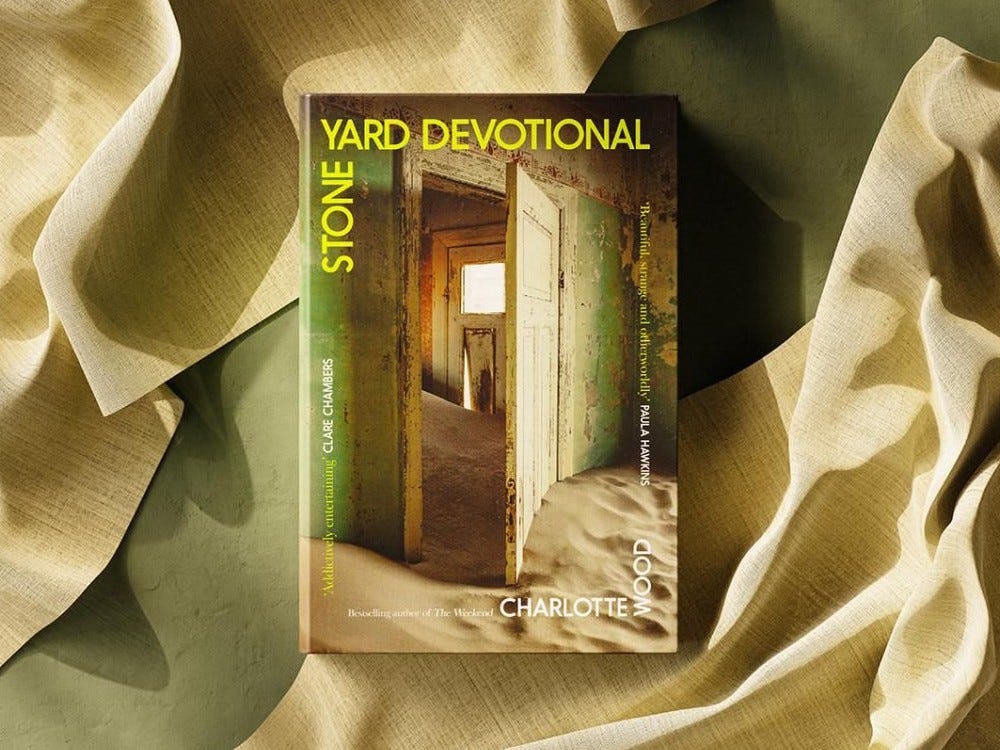
In a way, I guess, what I was hoping to see towards the end of last year was a critic who would do for Flesh what Catriona Menzies-Pike did, in November, for Charlotte Wood’s Stone Yard Devotional. Two weeks before Menzies-Pike’s essay on Wood appeared in the Sydney Review of Books, I’d written briefly about Stone Yard Devotional with some grumbles about its reception:
The question I kept coming back to while reading Stone Yard Devotional… was: why? Why can it not simply be said that [it] so fully embodies our expectations of “a good novel” that that is exactly and finally what it is? Why is it so hard to say that the novel is clearly the work of an intelligent and capable writer, but not a visionary one?—that it holds the reader’s attention for its duration, but not a moment longer?—that it ticks the boxes for programmatic admiration, but is otherwise unremarkable? I suspect that [its many rave] reviews overreach precisely because the novel is otherwise unremarkable: as if, today, there’s something intolerable about speaking of a novel whose straightforward competency deserves only polite appreciation.
Menzies-Pike, however, wrote in greater detail than I managed to—and more perceptively, more generously, more provocatively, more bravely.
Wood’s narrator is an Australian woman who abandons her life in the city, leaving her job and her husband, to seek a fresh start (of sorts) in a rural convent. Having devoted much of her life to the cause of climate justice, she has been brought low by care fatigue and decides to withdraw from the world, to strip back her commitments to any community larger than the convent’s. Menzies-Pike, to begin with, analyses the narrator on identitarian grounds. “It is implied,” she writes, that the narrator “is white,” and moreover:
She’s not broke, and nothing of her crisis seems to be a result of being broke. Her search for other values is intense, but money isn’t meaningful to her. She’s not at risk of violence and her self-destructive impulses are bloodless. As a young woman she joined forestry blockades, and her journal emits the residual whiff of genteel anti-capitalism. She’s a member of the knowledge class, or the PMC, or, if you’re on talkback radio, a member of the cultural elite, a greenie pushing unpopular causes. She is a middle-class, middled-aged white lady, which is to say, the dominant demographic buying and reading Australian fiction.
That last line is a loaded one, and it slightly complicates some things that Menzies-Pike goes on to say. For example, she describes the narrator as a kind of cipher for Wood’s readers, channelling widely-held fantasies of retreat from the mess of global affairs. “She is never named,” Menzies-Pike observes, “she never describes her appearance, or even appears to consider it”: on this basis, “this frictionless narrator could be anyone.” And although she does qualify that statement (“anyone who thought they had left their religious schooling well behind, anyone who yet craves the structures of meaning provided by organised religion”) she also repeats it thus: “The narrator could be anyone; we could be anywhere.” But it isn’t clear that the narrator really could be “anyone.” At best, maybe, she could stand in for any white (upper-)middle-class professional Australian woman.
This is germane because “the novel reflects the concerns and prejudices of a middle-class, middled-aged urban readership.” For many members of this readership, and arguably the women among them, those concerns involve an attunement to cultural discourses drenched in the language of grief, overwhelm, and “doing the work”: developing a consciousness of historical injustices and an awareness of one’s notional complicity in their legacy. And, as if to balance the scales, these same discourses are also marked by concerns with perceived vulnerability, emotional overwhelm and burnout, and their presumptive remedy: radical self-care, if not also the radical self-reinvention and self-indulgence of, say, Miranda July’s All Fours.
So, as Menzies-Pike points out, Wood’s narrator “is just as much shaped by contemporary online therapeutic cultures as she is by Catholicism.” But she goes further than I would in suggesting that Stone Yard Devotional prompts its readers to view the narrator sceptically. Initially, she establishes that the narrator is attuned to the above discourses:
[Recovery via withdrawal] is a lesson that the narrator urgently needs to learn, because her diary is a ledger of griefs and unburied corpses. … Griefs and deaths and losses accumulate, and the narrator has no ability to distinguish between them, to check her impulse to draw grotesque moral equivalences and connections. … She sees the brutal consequences of colonialism, registers the deaths of Indigenous people by illness, massacre, systemic injustice. The narrator is witless, disoriented as she tries to bear honest witness to this loss.
Then she concedes that the narrator’s withdrawal seems intended to represent an alluring prospect, if a largely impractical one, for readers:
Who cannot connect emotionally to this narrator’s desire to renounce contemporary life? Who, on the precipice of exhausted despair, has not toyed with a digital detox, or at least lamented that the parade of atrocity through all forms of media is too much, that the news is all too terrible? We might not be ready to cut all ties and move to an abbey… but Wood has presented her readers with a character whose dilemma is easy to understand and relate to, and is indeed the stuff of any number of digital lifestyle pieces.
Ultimately, though, Menzies-Pike argues that there’s a double risk in Wood’s positioning of the narrator as someone for readers to identify with, because the narrator is in fact an object of critique—and so too, then, is the reader who happens to share her sympathies, not to mention her identity markers. “The risk that Wood takes,” according to Menzies-Pike,
[is] to convey her thinking on survival and atonement to such a limited and self-involved narrator. … The risk is then doubled insofar as Wood has released her narrator in a cultural moment that already privileges narratives of self-improvement and recovery, and endorses self-care over community, the individual over the collective.
Consequently, “the reader is invited to reflect on their inclination to judge her, to see her self-deceptions, to reflect, surely, on their own.”
The word “surely” is doing some heavy lifting in that last sentence and it really can’t support the weight it’s meant to bear. I, for one, am not as sure as Menzies-Pike about the novel’s nudging of its readers towards self-critique. It’s not that I disagree with her when she argues that “there’s more to this novel... than its flailing anti-protagonist.” In fact, I fully agree with her assessment that there’s special significance to the character of Helen Parry, the abrasive and more worldly nun whose arrival at the convent “models a very different response to the crises of contemporary life.” Helen Parry is the only character whose appearances made Stone Yard Devotional come to life for me; I agree that this figure is the novel’s way of presenting its readers with an alternative to the narrator’s way of being, a vehicle for overcoming “the trope of the woman on the edge and the thousand appeals to women to slow down, to take care of themselves, to disconnect, to stop caring.” But I’m more ambivalent than Menzies-Pike when she identifies the novel’s “problem” in the way the narrator “struggles to look directly at her antagonist, even as she is on alert for her gaze and the moral authority it suggests.”
This persistent looking-away is a problem for Stone Yard Devotional, because it skews the novel towards functioning as an affirmation of the justness of the narrator’s withdrawal for radical self-care. Ultimately, I think, it’s a result of the ways in which Helen Parry remains always set apart, so that her individuality is imaginatively inaccessible to the narrator and, by extension, she is far less accessible to the reader than the narrator is. She is set apart societally, in the sense that she is a celebrity, a public figure, both lauded and vilified, who has forfeited the status of an ordinary person. She is set apart narratively, too, without much of a private life that is knowable to anybody, without the interiority or the articulacy to match the narrator’s introspection and lyricism. Finally, too, she is set apart as a kind of narratorial subordinate, a supporting character in the mode of those I’ve written about before: a screen onto which the narrator projects her own unease, a human conduit through which the narrator pursues catharsis for past sins. She isn’t seen on her own terms, as her own person, but only, at best, as an alter-ego and a foil.
The difficult question, for me, is as follows. If (a) Helen Parry represents a genuine alternative to the narrator’s outlook on the world and her actions in it, and if (b) an imaginative recognition of this alternative is suppressed in Stone Yard Devotional, and if (c) one implication of this suppression is the validation and affirmation of the narrator’s conduct, then does this failing belong to the narrator—as Menzies-Pike suggests—or does it belong to the novel and therefore the novelist? In other words, is Charlotte Wood the one who doesn’t recognise in Helen Parry the potential that Menzies-Pike does?
Belatedly in her essay, Menzies-Pike gestures towards this possibility: “Writing this,” she says, “I wished again that Charlotte Wood had extended her generous imagination to the figure of Helen Parry, who represents not respite from the world, but the necessary path back to it.” But while she backs away from a deeper investigation into the novelist’s intentions—or at least those intentions that can be presumed or inferred—there’s nothing to stop an interested reader from going down that rabbit hole. Being one such reader myself, I spent a good number of hours last year listening to Charlotte Wood discussing Stone Yard Devotional, interview after interview, festival chat after panel discussion after literary podcast. Since I wanted specifically to know more about the role of Helen Parry, I was listening out for any hint from Wood that that character gives us grounds for reading the novel against its narrator. Alas, I didn’t catch one.
Admittedly, Wood has often encouraged readers to take a guarded view of some of the narrator’s behaviour, but this has usually involved reprimanding the narrator for her brusqueness towards her fellow nuns, or for poeticising the mouse plague that overruns the convent. More usually, Wood suggests or agrees with her interlocutors that the narrator’s withdrawal is a reasonable course of action, even if a darkly romantic one. While she acknowledges that such a withdrawal is in practice unavailable to most of her readers, she doesn’t dissuade anyone from quietly desiring it. (For anyone who’d like to sample her comments in this vein, I’d especially recommend listening to her interview with Jill Eddington at the Byron Writers’ Festival, most notably between 24:17 and 33:08. You’ll hear similar things in conversations with Gregory Dobbs, at around 15:58, and Beejay Silcox, at around 8:16.) As it is for the novel, so it is for the novelist: sometimes implicitly, sometimes explicitly, validation goes to the narrator’s withdrawal, while the alternative represented by Helen Parry deserves respect, but isn’t viable.
Ultimately, Menzies-Pike wants to argue for a reversal: to rescue Helen Parry from her supporting role, to redeem Stone Yard Devotional by reading greater intricacy into its design. She concludes her essay by characterising Stone Yard Devotional as a novel that advances a “more confronting, less palliative” “play of ironies” for its likely readership, and therefore a novel that “can be two things at once: a moving allegory of grief and atonement, and a story of a self-absorbed white woman” who is problematised in more ways than I’ve glanced at here. But that final judgment reads like an effort to have one’s cake and eat it too: or rather to redeem a mediocre novel, asserting a degree of technical complexity that might elevate it above the level of the merely adequate. I think Menzies-Pike gives Wood the credit for her own generosity, for finding meanings in Stone Yard Devotional that owe more to the critic’s imagination than to the novelist’s. She elaborates on the novel’s subtleties in ways that are certainly intellectually rewarding, but—out of what might simply be her own sense of humility—she attributes them to the novelist when she is in fact their source.
This isn’t to criticise Menzies-Pike for what is, after all, a closely-observed and insightful piece of literary analysis. But it is to return to my own question about the reception of Stone Yard Devotional—“Why not just say that a good novel is ‘good’?”—and, now, to do so in light of my preceding concerns. If most reviews of Flesh were tickling the Simpsons—if they were essentially autogenerated responses to a prompt that forged thematic associations between the cultural discourse and a one-off literary datum—if they were attempts at performing a response to Flesh towards a part of the culture with more interest in the discursive value of the performance than in the experience of reading Szalay’s work—then what sort of output might we expect from a prompt that asked for an actual novel, instead of a review of one? Stone Yard Devotional seems like some sort of answer.
Obviously I don’t mean that Stone Yard Devotional is literally the output of some or another LLM. I’m not questioning Wood’s authorship. I mean that it reads like a novel written via a process not so distinct from so many reviews of Flesh. Again, the chain of thought behind it isn’t as crude as what led ChatGPT to tickle the Simpsons, but even if it’s more sophisticated, with all sorts of literary nuances and embellishments, it, too, comes across as the output of a prompt that operates on two premises. Premise x: it should appeal to contemporary readers of Australian literary fiction, or as large as possible a share of them. Premise y: it should take the form of a literary novel, with a narrator who speaks to the prior concerns of its likely readers, who expresses their fears, hopes, desires.
There’s an extrapolation occurring somewhere along the line, via associative logic with a dose of probabilistic gamesmanship. But whereas the reviews of Flesh extrapolated a theme for discursive purposes, Stone Yard Devotional extrapolates discursive characteristics from its probable readers, putting them into its narrator’s mouth and using them literally for the development of character. The logic feels like it runs through an articulation of questions somewhat like this: Who are the most probable readers of Australian literary fiction? What are the terms of the wider cultural discourse that address the same demographic? How might the probable values and norms of that demographic’s discourse inform the current aesthetic standards of literary fiction? Can a narrator maximise her address to readers within that demographic, quietly appealing to them, by adopting the terms of the discourse and affirming them—not imaginatively challenging them, despite creating a mechanism by which to do so—and turning them over, contemplatively, lyrically, in the very voice of literariness?
As above, Menzies-Pike describes her reading of Stone Yard Devotional, against the novel’s narrator, as “less palliative” than a more compliant reading. This rather raises the question of how the novel might be seeking to palliate its readers. My sense is that it does so by appropriating the stuff of “contemporary online therapeutic cultures” and casting a glamour over them. Repackaged in a literary form, this material becomes more dignified than the discourse allows it to be, being more cognate with the refinements of the “literary life.” Literature has an appearance, societally and culturally, that gives it more ballast than the cut-and-thrust of public airings can allow. But the set-up is rigged, the author’s thumb is on the scales, if, as literature, it domesticates rather than liberates Helen Parry, the narrator’s reverse image, the potential agent of her undoing. The domestication reduces that character to a thought experiment in a contained environment, and reduces the novel commensurately, from one that trades sincerely on the capacities of literature to one that leverages its literariness for its readers’ consolations.