

Glamour Lessons (1)
Reflections on a winter of discontent, beginning with "performative reading"

This post is the first of five on some literary discourses I’ve been mulling over, and making correspondences between, throughout the winter of 2025-26.
I have a personal library of give-or-take a thousand books. Some years ago, during an especially dismal period of my life, in a house half the size of what my family needed, in a situation that put us below the poverty line, a would-be acquaintance saw these books and said, “Wow. You must like people to know you’re very well-read.”
I remember that remark because it caught me off-guard, striking me somehow from two directions at once. First, there was the shock of being seen in a way I hadn’t anticipated. Until then, I’d given no thought to the impression those books might make on an observer. It’s true that I kept them in the front room of our house, visible to anyone who might peer in from the street, but that was just for convenience and somewhat out of desperation. I was living in cramped quarters; I had literally no other space to store them in. It simply hadn’t occurred to me that someone would see them as a curated display of my character, a means of projecting some image of myself to others.
And yet, together with this first shock, there was the shock of the sheer vacuity of what my acquaintance had inferred. Why look at the books and speak about them as if they had no substance beyond their spines? Surely, if they were to be taken up as a subject of conversation, anyone with any intellectual curiosity would zero in on a particular title and say something about its contents. For my part, as a person for whom the activity of reading is fundamentally private—since a book derives its value solely from the felt effects of the reading experience—I think I would’ve relished a conversation along those lines. It might’ve offered a chance to consider, or reconsider, or debate some of those books in ways I hadn’t done before then, given that nobody was otherwise enquiring into the impressions they made on me.
In short, my reasons for reading had nothing to do with how I might appear to others (still don’t, never will) and, for that very reason, the way others might’ve seen my books was no consideration of mine. I hadn’t imagined that anyone else took any interest at all in my library, certainly not enough to infer that I’d made an effort to cultivate the look of someone “well-read.”
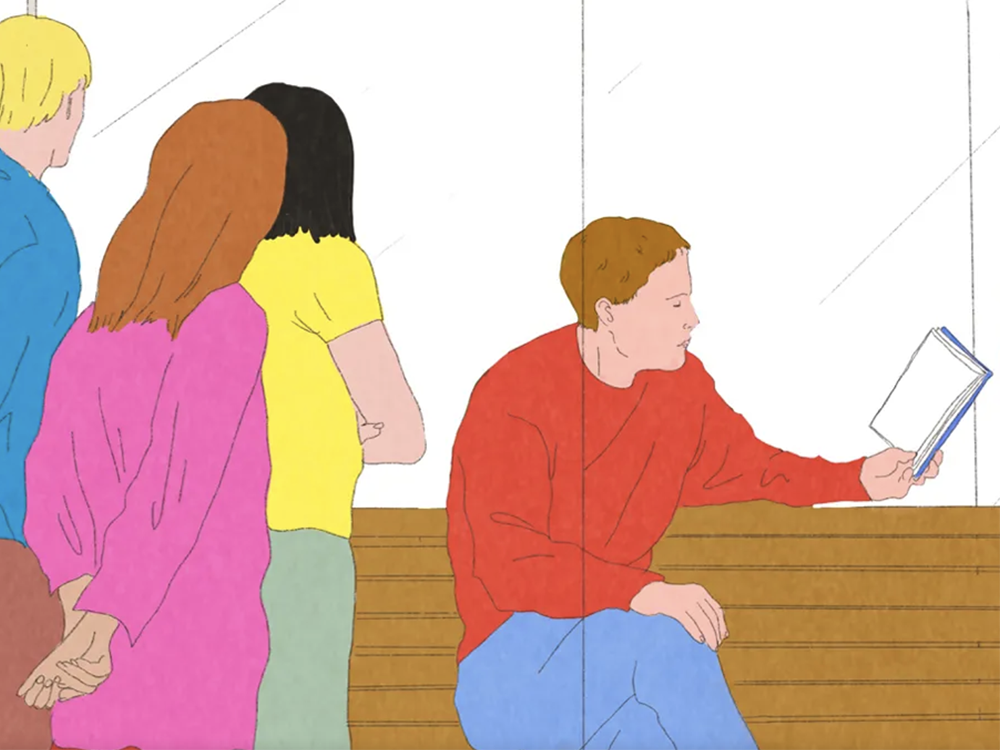
Anyway, late last year, I was reminded of this little incident when Brady Brickner-Wood wrote about so-called “performative reading” for The New Yorker. “Performative reading” is, apparently, a judgment of behaviour, which is at the same time a judgment of character, against a person (usually a man?) who engages in the unconscionable act of reading a book in public. Spectators to acts like these aver that this person can’t really be only reading a book, sustaining a private experience in the open for all to see, oblivious or indifferent to so very many other eyes. They must instead be merely performing the role of someone who is, or aspires to be, “well-read,” cultivating that very look in order to attract the interest of onlookers.
Very well. But what do those who cry “performative reading” understand about the reading experience? Obviously, for me, this experience is inwardly directed, confined to the internal life of one person, even when I’m engaged in it in a public area. More importantly—because more relevant to its very inwardness, its most private aspect—it involves a willed intellectual humility, a suspension of judgment, a surrendering of part of my consciousness to the words on the page, an entry into a state of uncertainty to be renegotiated with each sentence, which obviously isn’t visible to anyone. Under the gaze of Brickner-Wood’s spectators, however, the reading experience is inverted, evacuated of its internal dynamics and any hint of humility, becoming instead a vehicle for the adoption and maintenance of a persona for purposes that are ultimately narcissistic. As Brickner-Wood himself puts it,
A performative reader treats books like accessories, lugging around canonical texts as a ploy to attract a romantic partner or as a way to revel in the pleasure of feeling superior to others. While everyone else is scrolling social media and silencing life with noise-cancelling headphones, the performative reader insists upon his intelligence with attention-seeking insincerity, begging to be noticed with the aid of a big, look-at-me, capital-“B” book.
Of course, to really believe in performative reading, you have to be deep in Foucauldian and Debordian territory, probably unwittingly, and also, as Brickner-Wood points out, “severely online.” “This way of perceiving social reality—and particularly a person’s reading life—may seem inane,” he continues, “even deranged.” In his analysis, it’s a perception that arises among those who’ve long since accepted the individualised demands of neoliberalism (ie. that we are and must forever be entrepreneurs of the self) and who meet those demands within a societal order that casts all public interactions as manifestations of the spectacle. “Performative reading has emerged as a suspicious activity not because reading books is suspect,” he writes, “but because being beheld reading a book is understood to be yet another way for one to market himself, to portray to the world that he is indeed deeper and more expansive than his craven need for attention... suggests.”
But I don’t intend to take aim here at “performative reading” itself. It’s a fad accusation; it’ll pass and it probably already has. I’m more interested in the cultural residue of its emergence, in what the notion might suggest about prevailing ways of regarding literature and literary activities. I have a theory I’d like to talk for a walk: that literature, as a phenomenon, as a practice of both reading and writing, has fallen afoul of its own conceptual glamour.
That last word is one I use with care for its oldest denotations. Most people, I’d wager, hear the word “glamour” and find their thoughts turning to areas of life like haute couture: the catwalk, this season’s fashion, maybe the Condé Nast magazine of the same name. But take it from me, as a resident of the Scottish lowlands invoking a word with a Scots etymology, “glamour” has less to do with appearances as facts of being than with appearances as precisely that: mere appearances. What it connotes, broadly, is what you might call the “seeming-ness” of a thing, suggesting the possibility of ocular deception, since what it denotes is a manipulation of appearances via spellcraft or some other illusory practice. A “glamour” is a veneer thrown over something real, but mistaken for the real thing it obscures.
In my part of the world, I hear the word “glamour” used in this sense more than any other. Idiomatically, you can “cast a glamour” and you can “wear a glamour,” as if a glamour, on a person, were a kind of veil that conceals a true appearance and dazzles the eyes of onlookers. Loki, for example, often toys with the art of “glamoury” in the Marvel movies, and indeed it’s possible that the word entered the Scots lexicon via a southward emigration from that mischief-maker’s native territory. In Grettir’s saga, from medieval Iceland, a curse from an undead shepherd leaves the hero deceived and tormented by illusions whenever he wanders in darkness. The shepherd’s name is Glámr.
Here, then, is what I’m thinking. Literature, in itself, is a form of art that is highly individualised at both its point of origin and its point of reception. Ideally, the person who writes literature does so in order to stimulate an aesthetic experience for, in, and with the participation of the person who reads it. But, of course, since it isn’t entirely individualised—and can’t be, if it’s not absolutely solipsistic—there’s a societal aspect to it as well. Societally, we’re aware of the practices that literature depends on and entails, without which it simply couldn’t exist: the development of literacy, the stocking of printed volumes in bookshops and libraries, the reader’s retreat to a quiet space conducive to concentration. And then, subordinate to all this, we have a cultural concept of what a “literary life” might look like, how a person might appear to others if they value literature. When seen sentimentally, the literary life looks like shelves bending under the weight of beloved classics. When seen more superficially, it looks like Jane Austen-themed jigsaw puzzles, Popular Penguin covers on novelty mugs, and tote bags that say I WOULD PREFER NOT TO: tchotchkes for the self-professed “book lover.”
What’s important is that the societal concept of literature is decoupled from literature itself. This is to say that when we think of literature societally, we’re necessarily thinking of those aspects of literature that can be, and are, shared. The societal concept of literature can’t accommodate the private experience of reading literature, the individualised essence of literature itself: at best—at its very best—it forces the transmutation of the reading experience into an attempt at dialogue. And moreover, as a cultural concept, the “literary life” advances another decoupling, a secondary one. If literature, as a societal concept, is the aggregate of the practices that literature itself depends on and entails, the “literary life” is the aggregate of the sparks those practices throw off, the behaviours they imply and the behavioural traces they leave behind. Excised from this concept is what is involved in actually reading. Room remains only for suggestive evidence of someone’s having read.
I know, I know: that’s all quite abstract and convoluted. Let me try to simplify and make some clearer conceptual distinctions. Let’s say that the activity of actually reading is tantamount to an encounter with literature, qua literature, suspending our assessment of the experience thereof. Let’s then look at the observable evidence of having read—the detritus of the activity, the flotsam and jetsam of the encounter—and call it something else: literariness. Under this rubric, literature is an element of life as it is lived; literariness, in contrast, is a signifier of lifestyle. Literariness is appearance, not experience, the “seeming-ness” of a literary life: it is, in other words, the glamour that an encounter with literature casts into the world.
A notion like “performative reading” is what we get, I think, when a culture is primed to read literariness into an observable encounter with literature, beyond the observable signs of it: when reading is regarded primarily not as an encounter with literature, but as an activity by which the reader furthers their appearance of living a “literary life.” The question now is: what are the conditions that have made this mode of regard possible, even prevalent? The worry, for me, is that as the encounter literature itself casts a glamour into the world—as the activity of reading does indeed contribute to the concept of the “literary life”—our culture may have come to a point at which it casts the glamour right back: it substitutes the signs of the encounter for their source in individual experience, and fools itself into accepting the second- or third-order phenomenon as the first and the true. The reader of literature therefore finds their private experience considerably, even grotesquely, reduced. That experience, as a matter of cultural regard, now amounts to nothing more than the perpetuation of the “seeming-ness” that is, if not exhaustively, then at least sufficiently constitutive of literature itself.