


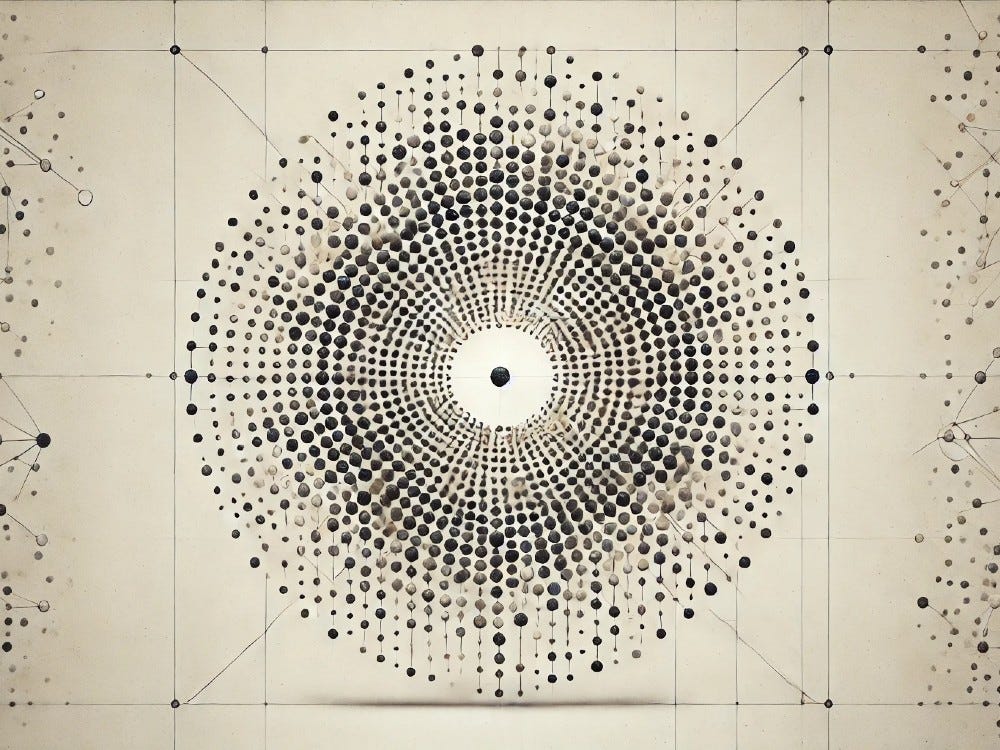
Banner image for ‘The Ubiquitous Point-of-View’ by David August at 3:AM Magazine.
This post is the final entry in a series on editing fiction for 3:AM Magazine. Click here to read my introduction to the series, with links to subsequent posts.
Fictions of abstraction are really fictions of rescission, multiplied. When a fiction of rescission takes rescission to an extreme, jettisoning more than one conventional element of narrative, it strides towards abstraction. It might not finally reach a state of true abstraction (think: the L=A=N=G=U=A=G=E poets) but it will extract itself from worldly sensations and experiences, and press itself deeper and deeper into a conceptual space, as it forgoes or abjures one or more of the basics: imagery, character, setting, dialogue, et al.
Arthur Mandal’s three stories give an idea of what abstraction feels like in very short bursts of prose. These stories do contain some of the above—the first relies heavily on imagery; the second on dialogue; the third on narrative action—but there’s no psychologising of the characters, no motive given for their desires and behaviour, and there are no stakes for any part of what the characters do, no gravity and no consequences to their decisions. Mandal’s people exist essentially in someone else’s dream state, not embedded in anything that the reader can recognise as a world. Similarly, Stephen Tuttle’s three stories retain one or two of the above elements, but to no purpose that feels meaningful. The events of the first scenario are all arbitrary, scarcely freighted as actual events in the narrator’s telling of them. The wishes and wants of the second narrator’s wife are pure abstractions of possibility, and the final narrator merely aggregates thoughts around a mental image of an object that as yet has no reality, no presence beyond the ideal of itself.
Other abstract fictions appear to describe perceptible events—in the sense that their sentences establish a chronology and track a series of cause-and-effect interactions between entities in a visualisable world—only to leave the reader wondering whether they add up to anything meaningful. These fictions do away with further developing such worldly entities, with complicating the interactions between them, with bestowing upon their interactions any lasting significance. Consider, for example, ‘Soft Furnishings’ by Benjamin Robinson. Introducing a young man “of talent and ambition” who “imagines himself inside a museum café cushion,” this fiction is generally about what it feels like for the young man to be inside the cushion and how he might respond when a woman sits on him. Eventually, he tries to send the woman a message through the cushion—a message that turns out to be the opening lines of the fiction itself—then he liquefies himself and dissolves the woman, leaving a ghostly version of the woman to haunt a featureless space. You might ask: why? The best answer would be: who cares? The fiction is what it is—an abstraction—and it posits that that alone is sufficient.
Much the same is true of Stephen Orr’s ‘The day he met Gustav Olafsson.’ Despite what the title would have you assume, Orr’s fiction is not about Gustav Olafsson or even the “he” who once met him. It’s about a woman who finds herself in a generally abstract setting—a circular room whose walls are lined with “six doors, equally spaced, numbered: 1, 2, 3, 4, 5, 6”—and how she responds when the room literally begins to shrink, to close in and constrict her. There might be a hint of a background for this woman, a sort of history filled with other people and various incidents, although neither she nor we can ever really be sure about that. In any case, there’s no real attempt to “flesh her out” or make her “a three-dimensional character.” There’s just nominally a person in what is ostensibly a place, some fragments of a possible personality, a mercurial chronology, and that’s it.
Finally, two abstract fictions at 3:AM have each committed to bending one of the abstractions that inhere in literature itself: abstractions of temporality and of perspective. In ‘The Infinity Line,’ Joe Bedford probes at the temporal mismatch between (1) the duration of the reading of words, (2) the moment of the comprehension of the meaning of those words, and (3) the time signature of the occurrence of the events to which those words refer. Indeed, Bedford tries to exploit this mismatch so that the three temporalities smash into each other; he theorises a system for the consideration of various temporalities’ proximity to infinity and nominates a “point-of-fold” at which they might braid together. And, in ‘The Ubiquitous Point-of-View,’ David August twists grammar in various ways (“When I first knew myself, there were only two of us”) to give narratorial perspective the same treatment that Bedford gives to time. The result is a commingling or unification of the first-person singular voice, the first-person plural voice, the second-person and third-person voices, and whatever alternatives might theoretically exist. It concludes:
I often go back to the world where there are only three, the place that allows the first pattern. Not so much to the world where it’s just me and one other, where everything stops. … When there are only three of us, I see one of them coming out of the other. It doesn’t get bigger or smaller, I can’t get closer or further away. It has no size, but you can’t miss it. It never goes away, even if they change positions.
When it’s only the three of us, I see a dot. So when they look at me, I must also be the dot. I must also be the background.
In a certain sense, this brings me back to where I began my retrospective overview of the fiction I’ve published at 3:AM. “When you first enter a work of prose,” I wrote back then, “before you get swept up in a story, before you can even determine a context, you’ll encounter a voice.” Whereas those initial works of fiction showed an interest in voice itself, in its tone and its rhythms, these more abstract fictions test the assumptions that precede the adoption of a voice. Every voice, after all, must speak from somewhere and somewhen—implying a perspective and a temporal location—but by making either or both of these uncertain, the fiction abstracts the very notion of a voice.
As I said at the outset of this exercise, in explicating some of the things I respond to when I’m reading submissions to 3:AM, I don’t mean to be overly determinative or to exhaustively map my preferences. Anything will win my attention, and receive close consideration, if it somehow breaks with conventions of style and structure in fiction. I just hope I’ve done justice to the many writers who’ve entrusted their unconventional fictions to me—and I hope I’ve given encouragement to others who might even now be puzzling over the work that will appear at 3:AM in the years ahead.